

When Music Stops Standing In For Love
Thoughts on love, infatuation, and growing up on Valentine's Day

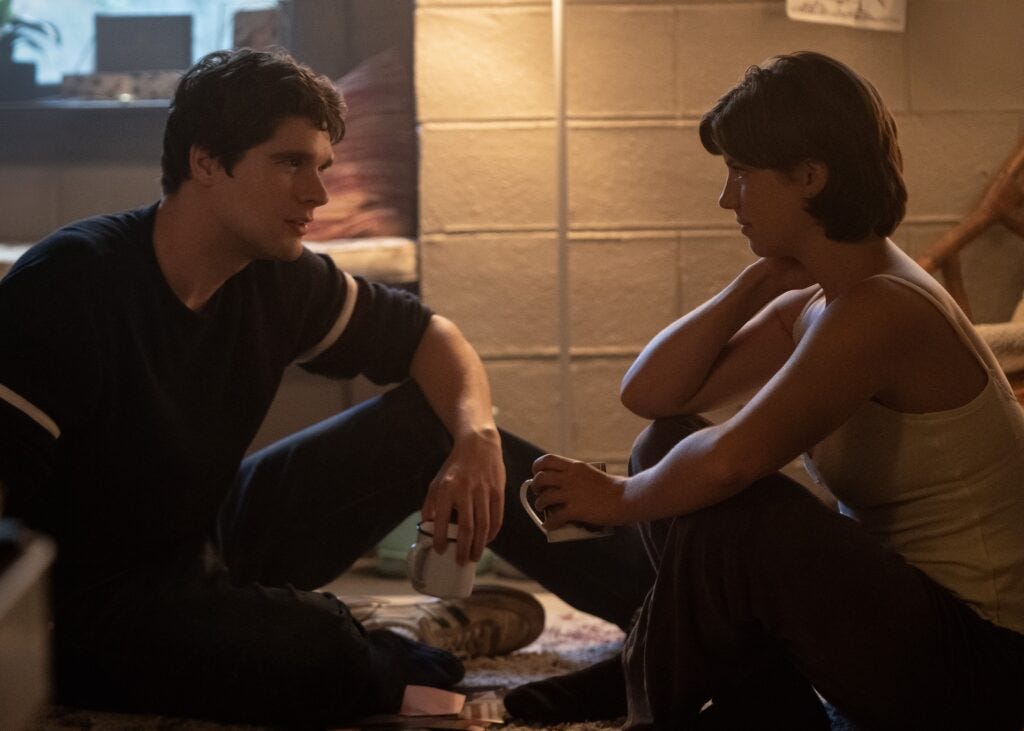
I love watching Tell Me Lies, and not only because I, like the main character, was once obsessed with a man named Stephen to the point of lunacy. The show is a soap-opera-esque, over-the-top drama centering a group of incestuous college students circa 2007, perfect for us millennials who attended college in the aughts, when the jeans flared and The Strokes blasted. There’s something soothing about remembering how young people can’t help but throw themselves into one emotional fire after the next, too innocent to know how to protect themselves, too oblivious to know how to protect their friends, only just figuring out who they are and so pushing every shred of feeling to its limit. I’m also fascinated by manipulative narcissists so it’s a bit like cat nip.
But my favorite part of the show is the music. I think everyone has an era, if you will, that constitutes their “music years.” When the heart of your musical taste is thoroughly cemented because your emotional landscape is running so wild, your feelings so ravenous and precarious that every song is dense with meaning, each lyric an attempt to make sense of the chaos around you, to fill in for all that’s lacking in your blind and immature interactions, and so you cling to songs to crystalize what it all means. Your life in those years is one long soundtrack that will forever remain, for better or worse, the soundtrack of your entire life if you’re being honest.
For me this was the aughts, specifically 2005 - 2012, which happens to be the exact era from which the songs in Tell Me Lies are pulled. Even the instrumental background music seems like a riff on The xx (and maybe it is! I have no idea, but I’m immediately transported to a mattress on the floor of some San Francisco dude’s Victorian, navy Jersey sheets showing a few too many stains, waiting to see if he’ll ask me to their show at The Fox). I was already out of college in that era, but I think what matters most is that it was the wildest and most romantically immature time of my life. College for me was heads down in problem sets, work-study, overnighting in computer labs. But my twenties were fun. Single with money for the first time in my life and a gaping hole of abandonment in my heart. Back then, I wanted nothing more than to channel some kind of creative spirit but I mostly spent my days creating PowerPoint decks. So I dated emotionally avoidant musicians, or, rather, men whose walls were lined with records, but were too insecure or lazy or both to create their own music. These were the men most likely to “get” me.
So I was watching the most recent ep of Tell Me Lies last night and suddenly BRIGHT EYES is playing in the background while Wrigley and Bree consummate a long run of will-they-won’t-they tension, and specifically LUA(!!) from I’m Wide Awake It’s Morning (2005), one of my favorite albums of all time, and the lyrics are slapping me in the face—so simple in the moonlight—like my ceiling just collapsed and suddenly a swarm of birds or bees or bats, something I absolutely do NOT want in my cozy 43-year-old bedroom, has invaded my space with the sole purpose of ravaging my entire emotional wellbeing. I’m now praying for the scene to end, actually holding my breath to see if I can make it through because at this point I’m really not sure. The number of times I’ve ran to this album, sometimes with tears streaming down my face, in order to process a painful heartache or a sea of mixed romantic signals is too many to count. I couldn’t possibly tell you the specifics of these heartaches, which can’t even be called breakups because they were all with quasi-situationships at best, but the terror hearing this song resurrected was truly visceral. As the song goes: The reasons all have run away, but the feelings never did.
A thing about one’s “music years”—they can not be rationalized or debated, they simply have to be indulged. Because very few of your favorite songs from these years are actually any good, they’re simply the songs that make you feel the most and the hardest. And that’s an infinitely personal thing. Which is alls to say—I promise to stop quoting Conor Oberst for the rest of the essay!
But before we completely move on, this is also how I felt watching, with awe, one of my favorite songs of all time played in Scott Hunter’s (François Arnaud’s) earbuds on Heated Rivalry. “I’ll believe in anything, and you’ll believe in anything,” Spencer Krug is suddenly shouting at me from my laptop perched gently on my pillow. Words I, too, have shouted dozens, possibly hundreds, of times while running, eyes wet, steeling myself to press play one more time.1 I felt almost betrayed watching this, like, wait, that’s my song!!! Like I was stripped naked, fully exposed, heart racing as this absolute fossil of my former self was spontaneously resurrected in a way that felt nearly dangerous, like a little gremlin waking up inside of me. A gremlin that has the capacity to run the show (ie. my soul) and in doing so destroy me slowly and steadily. A gremlin I’m pretty sure I once called passion.
I sometimes wonder whether or not I’m capable of feeling this gremlin-like passion again, and, though it’s hard to imagine, I think the answer is probably yes? You don’t spend forty years living off those fumes without some kind of permanent impact. But the bigger question is whether or not I want to feel that kind of passion again. Because when I think about it, my body freezes up—slam down the laptop of your heart!!—a clear trauma response when I imagine what comes next. Of course there is (supposedly) a kind of falling in love that does not involve the utter loss of self or make one’s heart freeze in terror. And in truth, I did mostly experience that with my current partner, who I was head over heels for but not in a way where friends and family were regularly reaching out to make sure I was okay. But I have no songs from the era of my partner and I falling in love. I have playlist sure, and gun-to-head, I could tell you a few songs that remind me of our coming together, but nothing that would elicit the physical response of my early situationships.
I’ll be forty-four in a month. I’ve been with my current boyfriend for five years— which feels insane—arguably the first stable partnership of my adult life. That little gremlin is no longer present (except apparently when I hear Wolfe Parade!). We got together when I was on the verge of forty, so my music years were long gone. I don’t feel butterflies with him, but I also don’t feel dread. I do feel joy and frustration, and white hot rage from time to time because you can take the girl out of her 20s but you can’t really take the drama out of the girl. But mostly I feel a sturdy sense of love. A freedom of having escaped the highs and lows of infatuation that requires music to stand in for feeling.
When Ben and I met—3,000 miles from home while I was chasing the aforementioned namesake of the Tell Me Lies villain—it was as if a million red flags had collided. We were both only just on the other side of respective emotional explosions. I don’t even know if I’d call them heartbreaks, as much as entire reorientations of the self, a respective waking up, as a result of someone else’s rejection. I assumed our relationship would only last a few months. So rarely did I have a soft place to land, I appreciated the warmth of his attention and care even if I thought we were in too fragile a state for it to go anywhere.
The heartbreak I had before Ben was a “music years” kind of heartbreak, in that it was misguided and never going to work. In that I intentionally chased someone who was not good for me, ignoring all the signs because at that time the distraction of running into a fire felt good. It felt like being alive. Until it felt very much like the opposite of that. It was a regression of self during an unstable time, and looking back felt like a sort of last hurrah. When it ended I felt absolutely no desire for that gremlin-like passion. You could say, at thirty-nine, I was finally open to stability.
Dating on the verge of forty, after that experience, felt very different. Mostly this was because I was finally chasing not just whatever activated my nervous system but what actually felt good. But also because my expectations were lower, in a sense. Not for the person, but for a relationship in general. I didn’t want someone to fill gaps in my identity or show me how to be. I wanted someone who could appreciate who I was.
I’ve seen many women talk recently about dating after a divorce. Women who start dating again for the first time in their 40s after being married often mention how nice it is to have a “boyfriend,” not look for a partner to complete something, be the perfect husband or the ideal father, but simply to enjoy and exist with, to forge intimacy without too much expectation. And yet this approach to mid-life dating, I’ve found, has nothing to do with whether or not you’ve been married before. It comes with age; divorce, schmi’vorce. There’s something relaxing about feeling sturdy in yourself, hard learned after too many falls, whatever those falls happen to be. Not assuming every relationship has to feel volcanic, and actually realizing that maybe it shouldn’t.
Not to say I don’t miss the thrill of that lava every now and then. Hence, I love nothing more than watching these kids run around blinded by feelings they can’t yet work through. It’s intoxicating and disorienting and thank god music is there to help us piece it all together when we need it. But most of the relationships in my life—romantic or not—where love is genuinely and mutually flowing are not associated with a song that has the power to make my heart stop without warning on a quiet Tuesday evening. These relationships don’t need music to fill the gaps, they’re loud enough in their own ways.
Happy V-Day!
Around this time last year, The New York Times referred to my debut novel, NOTHING SERIOUS, as a “rom-com.” And while being mentioned at all by The New York f’ing Times was earth-shattering, the descriptor was laughably off. I wrote an entire post on the matter, and my dear friend Sarah Kasbeer, who generously blurbed the book as “a slyly humorous and deeply relatable ode to female obsession,” coined the far more appropriate term: “traum-com.”
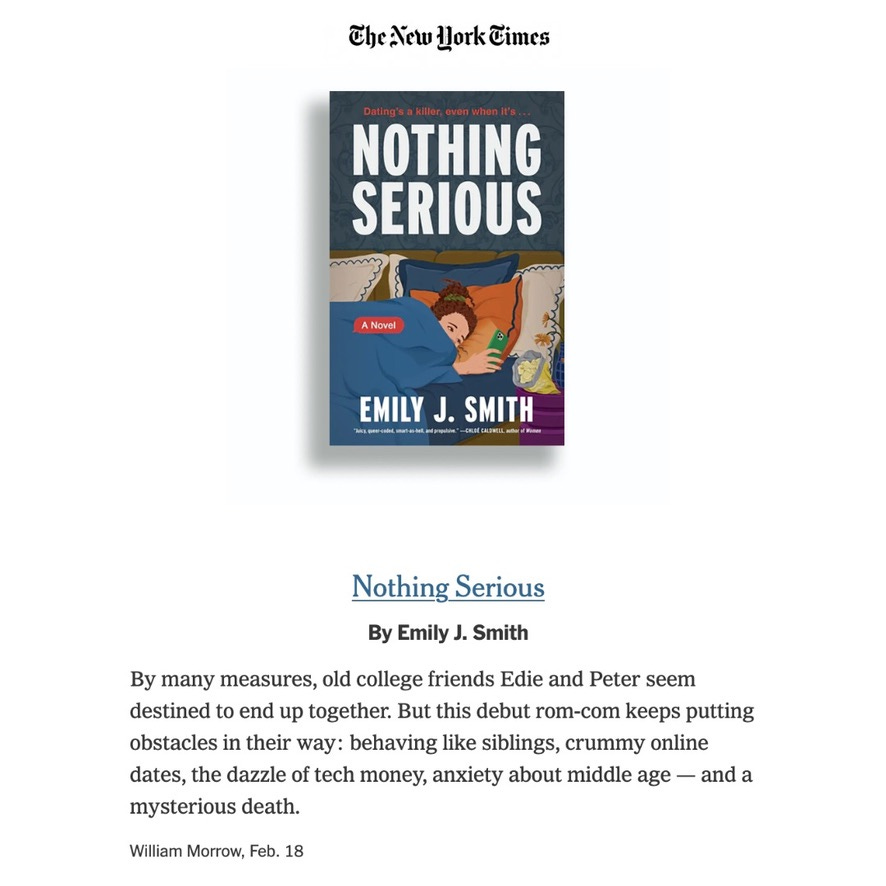
So, if all you want to do on V-day is curl in bed solo, covers pulled tight to chin, and feel solidarity with others who crave the same, might I recommend my debut novel?? More accurately called a “modern, feminist, dating world thriller” and “an unflinching and incisive look at modern dating, friendship, and obsession” it’s meant to be a fun, relatable read for anyone extremely sick and tired of dating apps, societal expectations on single, childless women, and all the ways men are let off the hook while women continuously bear he consequence of their mistakes. ❤️❤️
I always thought this line was “I’ll believe in anything, if you’ll believe in anything.” Somehow this felt more romantic, really the most romantic thing anyone could say. The “if” of it all—the codependence inherent, or maybe the freedom, the tension, of knowing there’s a choice, that at any moment it could all fall apart.
I talk CONSTANTLY about the music on Tell Me Lies. They played "I Used to Wait" by Arcade Fire recently, too, and I flipped. It's like my 20s coming back every episode!