

From Google Drafts to Book-In-Hand: A chat with Sara Petersen
The author of MOMFLUENCED and the writing friend I could not live without.

The other night, while trying to fall asleep, tears welled in my eyes as I imagined what I would say at my sister’s wedding. Despite the fact that she’s not even engaged yet, it’s an exercise I perform not infrequently since the challenge of capturing my feelings for her coherently and in public seems so otherworldly and impossible that I may as well get started early.
It’s a dramatic anecdote, but it’s all I can think about now, as I attempt to write a post summarizing one of the most important creative friendships in my life.
I met Sara Petersen in 2018, when we were both attending the Virginia Quarterly Review (VQR) Writers’ Conference for nonfiction. Anyone who has ever participated in writing workshops, especially of the nonfiction variety, knows you can often get a sense of who you’re going to get along with before you meet anyone, simply by reading their work.
I don’t remember the specifics of either one of our pieces but hers was something about navigating the ideals of motherhood, and mine something about untangling from expectations in male-dominated tech. Topics that seem, on the surface, utterly different, but, on closer look, were both self-deprecating thirty-somethings trying to untangle what it is we, as women, actually want beyond the goals society set for us when we were too young to consider it. Anyway, I was dying to meet her.
It’s said that it’s hard to make friends as an adult, but Sara and I spent that week in Virginia side by side like college kids, despite both being well into our thirties. Actually, we were exactly the same age, which only furthered our somewhat psychotic bond with shared references abound. A year later we would attempt to create a podcast called the Existential Xennial (which I maintain would have been a huge hit if either of us had any idea how to edit audio).
Same-age aside, our lives could not have been more different. Sara lived in a lovely house in the woods of New Hampshire with her then two (now three) children and husband, and I was as single as could be in a small Brooklyn one-bedroom. But that shared thing inside us that had us pitching any editor with an email in their Twitter bio like our lives depended on it, unabashedly obsessing over other women who seemed to have something “figured out,” and trying desperately to figure ourselves out through our writing, made the specific details of our lives irrelevant.
Since that week in Virginia, we have read more shitty drafts from each other than I could possibly count, and many great ones, too. We’ve had entire conversations, revelations, many times over, in the comments of our Google Docs. There is nothing like having someone who gets what you’re trying to do (not to mention all the insane thoughts you’re usually too ashamed to admit out loud). Who understands the fire of motivation that will make you spend weeks, sometimes months, writing an essay that will maybe earn you $150 if you’re lucky. Who is there to read a piece and then read it again and then read it again and who actually cares—really cares, so much so that a comment will go multiple paragraphs long and eight threads deep—about making that piece better. It is the most valuable thing in the world.
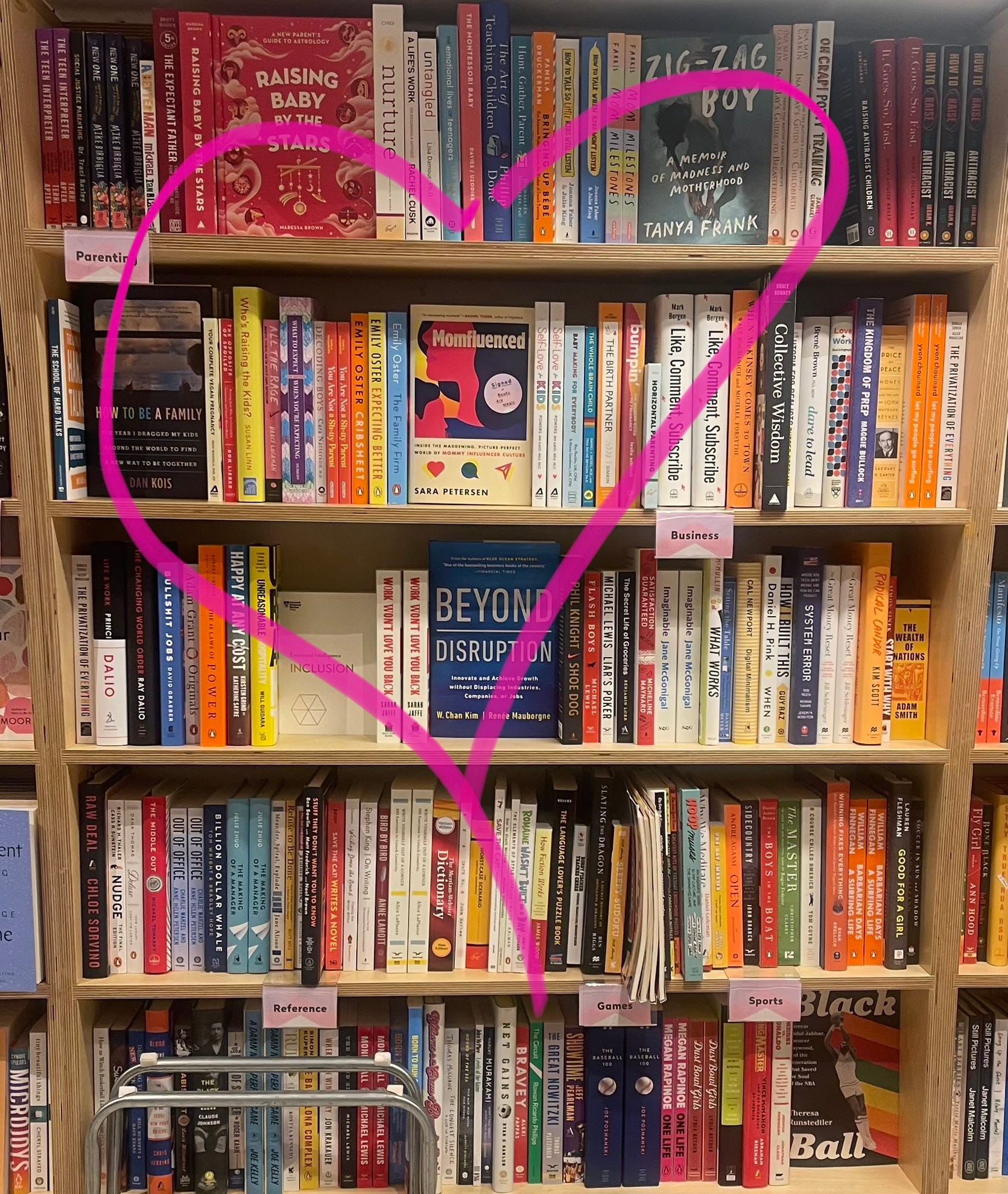
I’ve had the immense joy of seeing Sara’s words move from an idea in a text message, to a sometimes-winding first draft, to a stellar second draft, to the New York Times, to Harper’s Bazaar, to many more, and now an actual physical book on an actual fucking shelf!?! Sara’s first book, MOMFLUENCED: Inside the Maddening, Picture-Perfect World of Mommy Influencer Culture, came out last week. When I got a copy of her book, I cried. When I finished the book, I cried again (and you will, too).
It would be insincere not to mention that in all my joy there is of course longing and disappointment in my own lack of a physical book. As anyone close to me (Sara most of all) knows, I wish I had a book on the shelves, too (although hopefully there will be good news on this soon!). It’s all very depressing sometimes, how hard it is and how long it can take to get your work read—but you keep going! Which is to say, I understand how HUGE an accomplishment publishing is, how hard it is to get a book out there, and how much Sara deserves it.
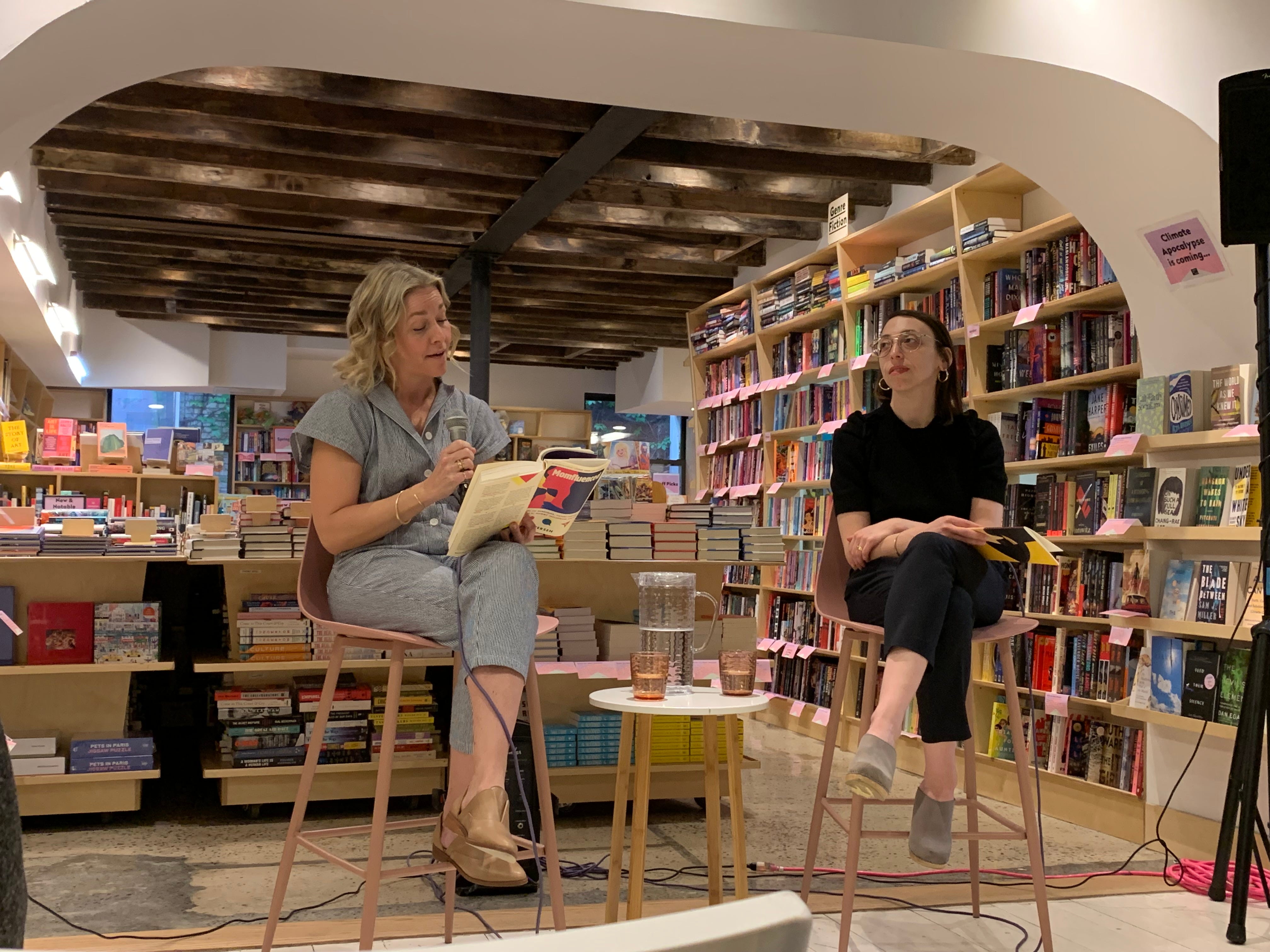
In last week’s episode of Poog, Queen Jacqueline explained that she is treating the upcoming taping of her one-woman show like a wedding (which I am attending, of course, rounding my total GOYK viewings to four). Very few things have made more sense to me. If and when I ever publish a book, I will treat the launch the way most people treat their wedding. And this is probably why Sara’s launch, which was held, to my great delight, in Brooklyn last week, reminded me of my sister’s hypothetical big day. And it was fabulous. She was incredible and we celebrated well into the night.
There are many wonderful pieces written about MOMFLUENCED—in Rolling Stone and Guernica, excerpts in Time and The Cut. The book, like all of Sara’s writing, is thoughtful and witty and beautiful. It’s also, now that she is unencumbered by the word count restrictions of a traditional essay, unbelievably thorough and considered. It pushes the reader to think critically not only about the way momfluencers shape our culture and what type of motherhood is allowed to be celebrated, but also how our culture, and its refusal to compensate the labor of mothers, has led to the rise of momfluencers. She has a way of inserting the most specific, relatable details of her own life that make a scene come alive, while coupling those details with academic research and interviews to precisely round out an insight.
Shortly before her book came out, we hopped on the phone to talk about the process of writing and promoting a book. This edited conversation focuses more on the journey of publishing than the book itself, which everyone can and should buy here.
ES: I want to talk about the shift from your initial book proposal of personal essays to your focus on reported journalism in MOMFLUENCED (although you do a great job of weaving your personal story into the book). How did you decide to go that route and do you prefer more journalistic writing?
SP: I don't know if I like one better than the other. I guess the more artistic side of me loves essays. I'm way more apt to, you know, get in the “artistic flow” or whatever they call it when you lose yourself, when I’m writing essays. That being said, I think, because I did a master's in literature there is a part of the research and reporting that feels very much like academic writing. And there's something nice about having other people be part of the story, so you’re not the only character. And I like talking to people. I really do like that part of it.
ES: What was the hardest part of your book journey? From, let's say, when we met at VQR—we both have these essay collections that we’ve done a million iterations of but no one wants—to, now, your book is launching in what four days (?!), you’re swimming in interviews and press requests. What was the lowest point of all that?
SP: I think it would have to be querying agents. Obviously, it's pure hell when you put your book out on submission [when your agent submits your book to publishers] and that book doesn't sell. But you still feel like, okay, I failed, but I have this person, my agent, in my corner. And I can cobble together a Plan B, and consult this person who is my key to the publishing industry. Whereas when you're querying agents, you have no key to anything and no way to open any doors. You’re completely alone. And it’s kind of black and white. You can't really publish a book without an agent. So, that sucked and it took a long time. So, yes, that was the worst.
ES: I always remember hating on people who were like “Oh, no! I got a book deal, now I actually have to write a book.” It’s like, I’m so sorry for you.
SP: I know, writing a book is hard, but no, that is not the worst problem to have. It's really not.
ES: Your book is around influencing and the performance of motherhood and social media. And writers are in this predicament where we also have to promote our work constantly on social media. What is your personal relationship to social media, and how do you manage that?
SP: I mean, it's so rough. It's just rough. If you're at all sensitive, or a people pleaser, or the type of person for whom a single comment will haunt your dreams for months, then, it's really hard. There's no way around it. I'm also super prone to jealousy and envy and feel all the things. So I don't know. I'm gonna reference the Poog episode.
ES: I think about Poog when I think about this question all the time.
SP: The hat episode, right?
ES: What is the hat episode, how am I blanking?
SP: They were talking about this—the hell of performing; Kate specifically was talking about the hell of being addicted to Instagram. So they adopted the hat plan, where they need an actual hat. You put the hat on when you're going in to promote your shit. And then you get out and you take the hat off.
ES: Brilliant, I can’t believe I don’t remember this. I’m going back to the archives.
SP: I mean, I would like it to be that clean. Obviously, if I'm posting something that I think is going to elicit a lot of external validation then, yeah, I'm fucking checking it like a drug addict.
ES: Hundred percent.
SP: It's terrible. So I don't know, I try to get in and get out. And sometimes I succeed, and sometimes I don't.
ES: I know, it’s like you can try and be super authentic, but then, in the trying, it’s obviously not. It’s hard to figure out what pose to take with social media, although I feel like you figured it out pretty well.
SP: I don't know. I feel like my formula is pretty simple in that I just rely on humor, self deprecation and sarcasm. And then I guess I'm “authentic” because I'm not wearing makeup most of the time? Like, what does that mean exactly?
ES: [Laughs] That’s so true, I don’t know.
So, I tend to focus on the most troubling and hardest part of things, but I also want to know what was the most gratifying part of your book journey?
SP: I should think about that, right? How healthy! I distinctly remember when I copy and pasted the Publishers Weekly deal announcement on Twitter. I definitely cried. That was, for whatever reason, the quickest access to true emotion for me. It’s just such an iconic Twitter moment that you see so many writers enjoy. Obviously, Twitter is a mess and dying. But the Twitter writing community is pretty unique. And the support feels genuine. And looking at it made me feel like it was real. I struggle to see things as real. And that made it easy to feel real.
Buy MOMFLUENCED here! ❤️
This was really great, and I'm glad to have found you via SP. I just finished Momfluenced last night... I knew it was going to be good, but it was better than good.